


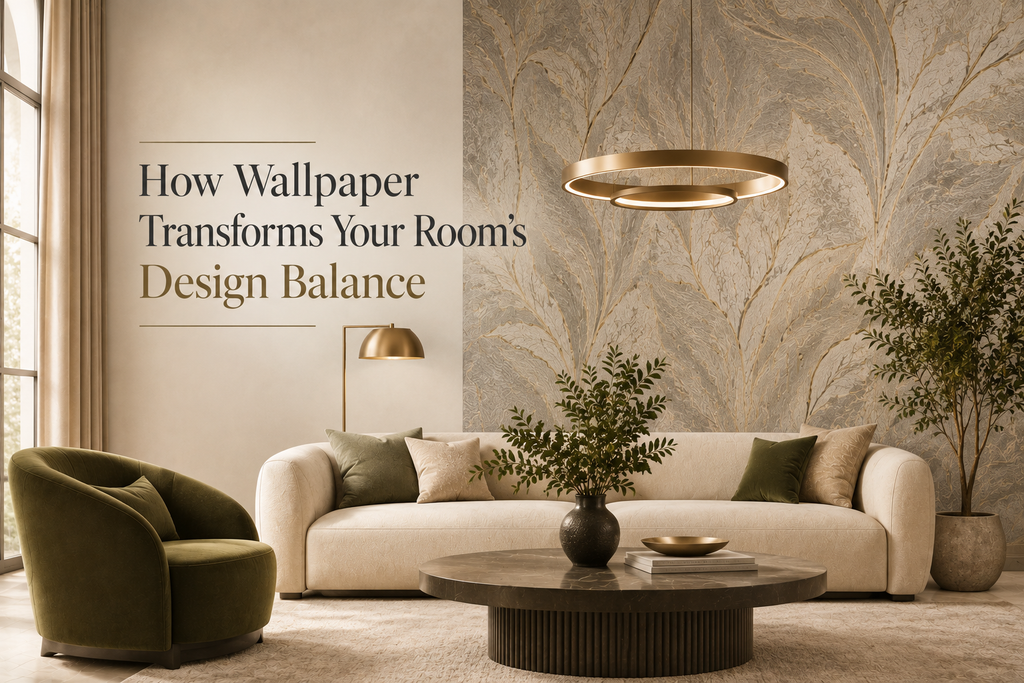
How Wallpaper Transforms Your Room's Design Balance
A well-designed room isn't simply a collection of beautiful things.
A beautiful sofa, an impressive light fixture, an elegant rug, and carefully chosen accessories can all look right individually and still feel wrong together.
Why?
Balance.
Interior design balance is about how color, scale, texture, pattern, furniture, and empty space relate to one another. When these elements are distributed thoughtfully, a room feels natural and cohesive. When one element dominates too much, the space can feel heavy, flat, chaotic, or unfinished.
Wallpaper can have a surprisingly powerful role in solving that problem.
Because walls occupy so much visual space, changing the wallcovering can change the entire balance of a room without replacing the furniture.
At Walloro, we see wallpaper as more than decoration. It can be the element that connects everything else.
What Does "Design Balance" Really Mean?
Balance doesn't necessarily mean symmetry.
A balanced room can be symmetrical, but it can also be completely asymmetrical.
What matters is visual weight.
A dark sofa has more visual weight than a pale chair.
A large patterned rug attracts more attention than a plain floor.
A textured wall can carry more visual presence than a painted surface.
Wallpaper becomes part of this equation because the walls provide one of the largest continuous surfaces in the room.
Changing that surface can shift the visual weight of the entire interior.
1. Wallpaper Can Balance Heavy Furniture
Imagine a room with a large sectional sofa, substantial coffee table, and oversized floor lamp.
The lower half of the room may feel visually heavy.
A completely blank wall above it can make the composition feel unfinished.
Wallpaper introduces visual weight to the upper portion.
A large-scale pattern or dimensional texture can create a stronger relationship between the furniture and the wall.
The room begins to feel vertically balanced rather than concentrated around the floor.
2. It Can Give Empty Walls a Purpose
Large blank walls aren't necessarily bad.
But sometimes they create a feeling that something is missing.
Instead of filling the wall with multiple pieces of artwork, shelving, or decorative objects, wallpaper can provide visual interest across the entire surface.
This is particularly useful in minimalist interiors.
A textured wallcovering can make an otherwise empty wall feel intentional without adding physical clutter.
3. Wallpaper Can Control Visual Weight Through Color
Color is one of the simplest ways wallpaper affects balance.
Light wallpaper
Can create a lighter visual presence and maintain an airy atmosphere.
Dark wallpaper
Can add weight and make a room feel more grounded.
Saturated wallpaper
Can become a strong focal element.
Neutral wallpaper
Can connect other colors without competing with them.
The important question isn't simply whether a color is beautiful.
It's how much visual attention it demands.
4. Texture Adds Balance Without Necessarily Adding Color
One of the advantages of textured wallpaper is that it can introduce visual complexity while keeping the color restrained.
This is particularly useful when a room already contains several colors.
A warm neutral textured wall can add depth without introducing another dominant hue.
The room gains another layer without becoming visually complicated.
5. Pattern Can Redistribute Attention
Pattern naturally attracts the eye.
That makes wallpaper a useful tool for redirecting attention.
If a room has a strong fireplace, artwork, or furniture arrangement, wallpaper can either reinforce that focal point or create a new one.
For example, a subtle pattern can support an existing focal point.
A dramatic pattern can become the focal point itself.
The choice depends on what the room needs.
6. Scale Is One of the Most Important Variables
Wallpaper pattern scale affects the balance of an entire room.
Small patterns create frequent visual repetition.
Large patterns create broader visual movement.
A large room with oversized furniture may benefit from a substantial pattern.
A smaller room with delicate furniture may work better with a more restrained design.
But there are no absolute rules.
Sometimes an oversized pattern in a small room creates exactly the dramatic effect you want.
The important thing is to consider the relationship between pattern scale and everything around it.
7. Wallpaper Can Connect Different Colors
A room may contain several colors that don't immediately appear connected.
For example:
-
Warm wood
-
Olive upholstery
-
Cream textiles
-
Black metal
-
Terracotta accessories
A carefully selected wallpaper can contain subtle variations of these tones and visually connect them.
This creates cohesion without requiring everything to match.
The wallpaper acts as a bridge.
8. It Can Balance Strong Flooring
Flooring can carry significant visual weight.
Dark hardwood, patterned tile, stone, or large area rugs can dominate the lower portion of a room.
A thoughtfully selected wallpaper can help distribute attention upward.
A textured neutral wallcovering may be enough.
In other cases, a stronger pattern can establish a more deliberate relationship between the floor and ceiling.
Think of the room vertically rather than only horizontally.
9. Wallpaper Can Create Symmetry Without Perfect Matching
Symmetrical furniture arrangements are not always necessary.
Wallpaper itself can create a sense of visual organization.
A repeating pattern establishes rhythm across the wall.
That repetition can make asymmetrical furniture arrangements feel more cohesive.
This is particularly useful in contemporary interiors where perfect symmetry isn't always desirable.
10. It Can Balance Windows and Architectural Openings
Windows naturally create strong visual interruptions.
A wall may contain:
-
Large windows
-
Doors
-
Arches
-
Built-in shelving
-
Niches
Wallpaper can unify the remaining surface.
A continuous texture can make the wall feel cohesive.
A patterned design can create rhythm around architectural openings.
This helps prevent the wall from feeling fragmented.
11. Wallpaper Can Balance High Ceilings
Tall rooms often have a lot of visual weight above eye level.
Wallpaper can either emphasize or soften this.
Vertical patterns can celebrate height.
Large-scale patterns can give the wall greater horizontal presence.
Dark colors can make the upper volume feel more grounded.
Architectural divisions such as molding and wainscoting can introduce additional proportion.
Wallpaper becomes a tool for controlling how the room's height is experienced.
12. It Can Make Low Ceilings Feel More Intentional
Low ceilings don't necessarily need to be disguised.
Instead, wallpaper can make them feel purposeful.
A subtle vertical pattern can create upward movement.
A tonal texture can prevent the ceiling from feeling visually heavy.
A continuous wall treatment can create a calm, unified environment.
The goal isn't always to make the ceiling appear higher.
Sometimes it's to make the entire room feel more cohesive.
13. Wallpaper Can Balance Minimalist Furniture
Minimalist furniture often has clean lines, limited decoration, and restrained color.
That simplicity can be beautiful.
But when everything is extremely smooth and neutral, the room can lack depth.
Textured wallpaper can solve that without compromising the minimalist aesthetic.
The furniture stays simple.
The wall provides tactile interest.
This creates a layered environment without visual clutter.
14. It Can Also Calm Maximalist Interiors
Balance works in the opposite direction too.
If a room already contains:
-
Patterned upholstery
-
Decorative accessories
-
Bold artwork
-
Colorful rugs
-
Statement furniture
The wallpaper doesn't necessarily need to add another strong pattern.
A tonal or textured wallcovering can give the eye somewhere to rest.
This is one of the most important principles of successful maximalism:
Not everything needs to compete.
15. Wallpaper Can Define a Focal Point
Every room benefits from some form of visual hierarchy.
You should be able to tell where the eye is meant to go first.
Wallpaper can establish that hierarchy.
A feature wall behind a bed can become the bedroom's focal point.
A dramatic wall behind a dining table can define the dining area.
A textured fireplace wall can emphasize architecture.
The wallpaper helps tell the eye where to begin.
16. It Can Create Balance in Open-Plan Interiors
Open-plan spaces can sometimes feel like one enormous room without clear visual organization.
Wallpaper can help define individual zones.
For example:
Living area: subtle textured wallpaper
Dining area: stronger pattern
Kitchen: restrained neutral wallcovering
The spaces remain physically connected while developing individual identities.
17. Texture Can Balance Smooth Materials
Modern interiors often contain smooth materials such as:
-
Glass
-
Polished stone
-
Lacquer
-
Metal
-
Smooth cabinetry
Too many smooth surfaces can make an interior feel cold.
Textured wallpaper introduces another tactile layer.
A woven finish can soften polished surfaces.
An embossed pattern can add dimension.
A natural-inspired texture can create warmth.
The wall becomes a counterpoint to the harder materials.
18. Wallpaper Can Balance Modern and Traditional Elements
Many homes combine different design eras.
You might have:
A contemporary sofa + antique cabinet.
Modern lighting + traditional molding.
Minimalist furniture + vintage accessories.
Wallpaper can help these elements coexist.
A transitional design can bridge the styles through pattern, texture, and color.
Rather than making every element belong to the same period, the wall provides a common visual language.
19. Think About Balance From Every Angle
A room isn't experienced from a single viewpoint.
Consider how the wallpaper interacts with the room from:
-
The doorway
-
The sofa
-
The dining table
-
The hallway
-
Adjacent rooms
This is especially important in open layouts.
A wallcovering that looks perfect from one angle may create too much visual intensity from another.
The best designs work across multiple viewpoints.
20. Don't Confuse Balance With Matching
A balanced room doesn't require everything to coordinate perfectly.
In fact, overly coordinated interiors can feel predictable.
Balance is more about relationships than matching.
The wallpaper can contrast with the furniture.
The colors can differ.
The textures can vary.
What matters is that the overall visual weight feels intentional.
How to Use Wallpaper to Improve Room Balance
Before selecting your wallcovering, look at the room as a whole.
Step 1: Identify the Heaviest Element
Is it the sofa? Rug? Fireplace? Flooring?
Step 2: Look at the Walls
Are they visually empty or already busy?
Step 3: Decide What Needs More Attention
Does the room need a focal point or a quieter backdrop?
Step 4: Consider Color Weight
Would a dark, light, or tonal wallcovering create better balance?
Step 5: Evaluate Pattern Scale
Look at the size of the furniture and the dimensions of the wall.
Step 6: Add Texture Where Necessary
Use texture to introduce depth without necessarily adding stronger color.
Step 7: Step Back
Don't judge the wallpaper only from sample distance. Consider the complete room.
Common Wallpaper Balance Mistakes
Choosing a Pattern That Is Too Small
A tiny repeat can become visually insignificant on a large wall.
Using Too Many Strong Patterns
If furniture, rugs, curtains, and wallpaper all compete, the room can feel chaotic.
Ignoring Existing Architecture
Wallpaper should work with molding, windows, doors, and built-ins.
Matching Everything Too Closely
Perfect coordination can remove contrast and depth.
Forgetting Texture
Color isn't the only way to create visual interest.
Choosing Wallpaper Without Considering Lighting
A wallcovering can look dramatically different under natural and artificial light.
Why Walloro Believes Balance Starts With the Walls
At Walloro, wallpaper is approached as part of the complete interior rather than an isolated decorative layer.
Our wallcoverings explore texture, pattern, dimensional finishes, organic inspiration, and sophisticated color to give designers and homeowners more ways to shape visual balance.
Sometimes the wall needs to speak loudly.
Sometimes it needs to quietly support the furniture.
Sometimes it needs to connect several unrelated elements.
And sometimes the most successful wall is the one you barely notice—but everything around it looks better because it's there.
That's the real power of thoughtful wallcovering.
Frequently Asked Questions
Can wallpaper really change the balance of a room?
Yes. Because walls occupy such a large visual area, changes in wallpaper color, texture, pattern, and scale can significantly affect the room's overall visual weight.
Should wallpaper be lighter or darker than the furniture?
Either can work. A lighter wall can create an airy backdrop, while a darker wall can add depth and make lighter furniture stand out.
Does textured wallpaper help balance a room?
Yes. Texture can add visual depth without introducing another strong color or pattern, making it useful for both minimalist and layered interiors.
Can wallpaper make a room feel less cluttered?
It can. A carefully selected tonal or textured wallpaper can provide visual interest without requiring additional decorative objects.
Should every room have a feature wall?
No. Some interiors benefit from continuous wallpaper across multiple walls, especially when the design is subtle and the goal is overall cohesion.
How do I know if my wallpaper pattern is too strong?
Look at the wallpaper alongside your furniture, flooring, rugs, and lighting. If your eye is immediately pulled toward the wall while everything else disappears, the pattern may be carrying too much visual weight.
Final Thoughts
Design balance isn't about making every element equal.
It's about making every element relate.
Wallpaper can redistribute visual weight, connect colors, introduce texture, establish rhythm, emphasize architecture, and create a focal point—all without changing the physical structure of the room.
A wall can make furniture feel lighter.
A pattern can make an empty space feel intentional.
A textured surface can soften modern materials.
And a carefully chosen color can bring an entire palette together.
At Walloro, we believe the most successful interiors aren't the ones where every element demands attention.
They're the ones where every element knows its place.