


Wallpaper as Architecture: Design Beyond Furniture
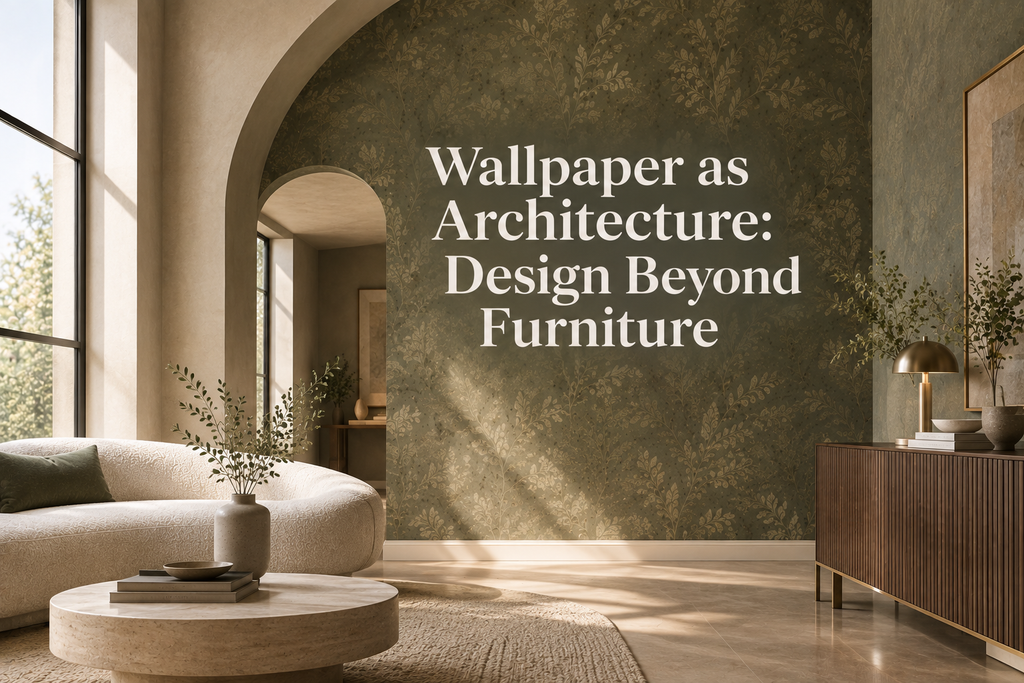
Wallpaper is often treated as decoration—a beautiful layer added after the room's architecture, furniture, and lighting have already been decided.
But what if wallpaper could do more?
What if a wallcovering could define proportions, emphasize structural features, create visual boundaries, alter the perception of depth, and give an otherwise ordinary wall a stronger architectural presence?
This is where wallpaper as architecture becomes an interesting design concept.
Instead of asking which wallpaper matches the sofa, the question becomes more fundamental:
How can the wallcovering help shape the way the room is experienced?
For a design-focused brand like Walloro, this approach moves wallpaper beyond surface decoration. Pattern, scale, texture, repetition, and placement become tools for creating visual structure.
The result doesn't necessarily need to be dramatic. In many sophisticated interiors, the most effective architectural wallpaper is subtle enough to feel like it was always meant to be there.
Wallpaper Can Do More Than Decorate a Wall
Architecture gives a room its physical structure.
Walls establish boundaries. Ceilings establish height. Doorways connect spaces. Windows control light. Columns divide volumes. Niches create depth.
Wallpaper cannot change these physical elements, but it can change how we perceive them.
A carefully selected wallcovering can:
-
Emphasize vertical height
-
Reinforce horizontal lines
-
Highlight architectural symmetry
-
Make a niche feel deeper
-
Give a long hallway greater rhythm
-
Create visual zones in open spaces
-
Frame architectural features
-
Add depth to flat surfaces
-
Establish continuity between connected spaces
This makes wallpaper particularly interesting as a design material.
It doesn't replace architecture.
It interprets architecture.
What Does "Wallpaper as Architecture" Actually Mean?
The concept is less about literally turning wallpaper into a structural material and more about treating the wallcovering as part of the architectural composition.
Traditional decorating often follows this sequence:
Architecture → furniture → accessories → wallpaper
An architectural approach can reverse the relationship:
Architecture → wallpaper → furniture → accessories
The wallcovering becomes one of the elements that establishes the room's visual identity.
This can be especially effective in spaces where furniture isn't the main source of character.
Think about an empty room with tall ceilings, large windows, curved openings, or beautiful molding.
Even without furniture, the architecture already tells a story.
Wallpaper can strengthen that story.
Walls Are Part of the Room's Geometry
Every room contains visual geometry.
There are vertical walls, horizontal ceilings, openings, corners, recesses, and repeated architectural elements.
Wallpaper patterns introduce another geometric layer.
A vertical pattern can reinforce vertical architectural lines.
A horizontal design can emphasize width.
A repeating geometric pattern can echo the structure of cabinetry or window arrangements.
A flowing botanical pattern can provide organic contrast against rigid architectural lines.
The pattern doesn't have to copy the architecture.
Sometimes the strongest result comes from responding to it through contrast.
Pattern Can Create Architectural Rhythm
Architecture often feels organized because elements repeat.
Windows may appear at regular intervals.
Columns may divide a wall into equal sections.
Doors may create a sequence along a corridor.
Wallpaper naturally introduces repetition.
This makes it an effective tool for creating rhythm.
A small repeating motif can make a large wall feel more structured.
A geometric pattern can reinforce symmetry.
A larger design can establish a slower, more dramatic rhythm.
The key is considering the distance between the pattern's repetition and the room's architectural elements.
If the rhythm feels compatible, wallpaper can make the entire room feel more intentional.
Can Wallpaper Change the Perception of Height?
Yes—visually.
Wallpaper cannot physically raise a ceiling, but pattern direction can influence how the room's proportions are perceived.
Vertical lines and elongated motifs can draw the eye upward.
This can work particularly well in:
-
Entryways
-
Staircases
-
Rooms with tall walls
-
Traditional interiors
-
Narrow spaces
-
Rooms with unusually high ceilings
However, vertical pattern isn't the only solution.
A large-scale design can also create a strong sense of vertical composition when the artwork or motif naturally moves upward across the wall.
The goal is not to trick the eye.
It's to make the room's existing proportions feel intentional.
What About Low Ceilings?
Low ceilings require a different approach.
Instead of emphasizing the horizontal boundary between wall and ceiling, you can choose designs that create visual movement upward.
Subtle vertical motifs, elongated botanical forms, or restrained textures can prevent the walls from feeling visually compressed.
Lighter colors can also help maintain openness, although dark wallpaper isn't automatically unsuitable.
A dark ceiling and dark walls can sometimes create an immersive effect rather than making a room feel smaller.
The architectural approach is about understanding the effect you want—not following a universal formula.
Wallpaper Can Define Zones Without Building Walls
One of the most useful architectural applications of wallpaper appears in open-plan interiors.
Modern homes often combine:
-
Living rooms
-
Dining areas
-
Kitchens
-
Home offices
-
Entry spaces
There may be no physical wall separating these functions.
Wallpaper can create a visual boundary.
For example, a distinctive wallcovering behind a dining area can establish that zone without adding a partition.
A different texture behind a reading area can give it its own identity.
A bold pattern can distinguish an entryway from an adjoining living space.
The physical floor plan stays exactly the same.
The visual architecture changes.
Wallpaper Can Frame an Architectural Feature
Some walls already have a natural focal point.
It might be:
-
A fireplace
-
An arch
-
A built-in bookcase
-
A window
-
A niche
-
A sculptural staircase
-
A decorative molding system
Wallpaper can act as a frame around these elements.
A restrained design can make the feature feel more prominent without competing for attention.
A dramatic pattern can make the feature part of a larger visual statement.
The important consideration is hierarchy.
Ask:
What should the eye notice first?
If the fireplace is supposed to dominate, the wallpaper should support it.
If the wallcovering is intended to become the focal point, the architectural feature may need a quieter treatment.
Good design is often about deciding what deserves attention.
Texture Can Become an Architectural Layer
Pattern isn't the only way to make wallpaper architectural.
Texture can be equally powerful.
Embossed and textured wallcoverings create subtle variations in light and shadow across a surface.
This can be especially effective on large uninterrupted walls.
As natural light moves through the room, the wall can appear to change throughout the day.
Texture can give a flat wall a greater sense of depth without introducing a strong graphic pattern.
This is one reason textured wallpaper can work beautifully in minimalist interiors.
The room remains visually restrained, but the walls aren't completely flat.
Wallpaper and Architectural Lighting
Lighting and wallpaper have a particularly important relationship.
Wall sconces, recessed lighting, pendant lights, and natural daylight all interact with the wall surface.
A textured wallcovering can produce shadows beneath directional light.
A metallic detail can reflect light.
A matte surface can absorb it.
A patterned wallpaper can create changing visual emphasis depending on where the light falls.
Before selecting a wallcovering, consider the lighting that already exists.
Then ask:
-
Where will shadows fall?
-
Which areas receive direct daylight?
-
Are there wall sconces?
-
Will the pattern be illuminated from the side?
-
Does the wallpaper have texture?
-
Will artificial lighting change its color?
The wall should be designed for both daylight and evening use.
Architecture Doesn't Mean Everything Has to Match
An architectural approach does not require wallpaper, furniture, flooring, and architecture to share the same style.
In fact, contrast can be valuable.
Consider a contemporary geometric wallpaper inside a traditional home.
The architecture provides heritage.
The wallpaper introduces a modern interpretation.
Or consider a soft botanical wallcovering inside a highly contemporary room.
The architecture provides structure.
The wallpaper introduces organic movement.
These combinations can make interiors feel layered rather than predictable.
What Happens in Historic Homes?
Wallpaper can be particularly interesting in older properties.
Historic homes often contain architectural details that newer construction doesn't naturally provide:
-
Decorative molding
-
Tall ceilings
-
Fireplace surrounds
-
Paneling
-
Arches
-
Detailed door frames
-
Deep window reveals
Wallpaper can highlight these features while allowing the room to evolve stylistically.
A traditional pattern can reinforce the home's character.
A contemporary pattern can create contrast.
A textured neutral can allow the architectural details to remain the primary focus.
The important thing is to understand the building rather than simply copying its age.
What Happens in Modern Homes?
Modern architecture presents a different opportunity.
Clean lines and minimal detailing create large uninterrupted surfaces.
Wallpaper can introduce visual interest without adding physical complexity.
A subtle textured wallcovering can add warmth to a minimalist room.
A geometric pattern can reinforce the building's linear character.
An organic design can soften a highly rectilinear interior.
In a modern home, wallpaper can become the decorative equivalent of an architectural material.
Wallpaper Can Create Depth Without Changing the Floor Plan
One of the most interesting effects of wallpaper is its ability to influence perceived depth.
Large-scale patterns can create layers.
Textured surfaces can create shadows.
Low-contrast designs can visually extend across a wall.
Darker colors can create a sense of enclosure.
Lighter designs can maintain openness.
Wallpaper cannot physically move the walls, but it can change how the eye interprets the space between them.
That makes it a powerful tool in interior composition.
Think About Sightlines
Architectural design isn't experienced from one fixed position.
You see a room while:
-
Entering through a doorway
-
Walking down a hallway
-
Sitting on a sofa
-
Standing in a kitchen
-
Looking through an arch
-
Moving between rooms
These sightlines matter.
A wallpaper may look beautiful when viewed directly but feel disconnected when seen from an adjacent room.
Before committing, consider where the wallcovering will be visible.
This is particularly important in open-plan homes and spaces with multiple connecting doorways.
Wallpaper Can Connect Separate Spaces
The opposite is also possible.
Wallpaper can create continuity between rooms that don't physically connect.
You might repeat:
-
A color family
-
A texture
-
A motif
-
A material relationship
-
A similar pattern scale
The actual wallpaper doesn't need to be identical.
Instead, a common visual language can create a sense of architectural continuity.
This allows each room to have its own personality while still belonging to the same home.
The Ceiling Is Part of the Composition
If wallpaper is being considered architecturally, the ceiling cannot be ignored.
The wall-to-ceiling relationship determines how the room feels.
In some interiors, continuing wallpaper onto the ceiling can create an immersive effect.
In others, keeping the ceiling quiet provides necessary contrast.
The decision depends on:
-
Ceiling height
-
Pattern scale
-
Natural light
-
Room size
-
Architectural detail
-
Wallpaper intensity
There is no universal rule.
The important thing is that the ceiling is considered as part of the composition rather than treated as an afterthought.
Furniture Becomes a Secondary Layer
When wallpaper is designed architecturally, furniture doesn't disappear from the equation.
Instead, its role changes.
Furniture should interact with the wallcovering without controlling it completely.
This can create greater flexibility.
If the sofa changes in five years, the wallcovering can still make sense because it was selected for the architecture rather than a specific upholstery color.
This is one reason an architectural approach can contribute to a more enduring interior.
A Useful Way to Select Architectural Wallpaper
Start with the room itself.
Step 1: Identify the Architecture
Look for the strongest permanent features.
Step 2: Define the Desired Effect
Do you want to emphasize height, depth, symmetry, intimacy, openness, or rhythm?
Step 3: Choose Pattern or Texture
Decide whether the room needs visual movement or a quieter dimensional layer.
Step 4: Consider Scale
Make sure the pattern relates to the size of the wall and architectural elements.
Step 5: Test the Lighting
Observe the sample in daylight and artificial light.
Step 6: Consider Sightlines
Look at the wallpaper from the entrance and adjacent spaces.
Step 7: Add Furniture
Only after understanding the wall's architectural role should you finalize the furniture relationship.
This process can lead to much more intentional results.
Common Mistakes
Treating Wallpaper as an Afterthought
If the wallcovering is selected at the very end, its architectural potential may be overlooked.
Matching the Sofa Too Literally
A wallpaper chosen only to coordinate with upholstery can become dependent on one piece of furniture.
Ignoring Pattern Scale
A design can feel entirely different depending on the dimensions of the wall.
Forgetting the Ceiling
Wall and ceiling proportions are closely connected.
Overemphasizing Every Feature
Not every architectural detail needs to become a focal point.
Ignoring Transitions
Wallpaper should be considered from connecting rooms and corridors, not just from inside the room itself.
Frequently Asked Questions
Can wallpaper really be considered architecture?
Wallpaper isn't structural architecture, but it can function as an architectural design layer by influencing visual proportions, rhythm, boundaries, depth, and emphasis.
Can wallpaper make a room look taller?
Certain vertical patterns and elongated motifs can emphasize upward movement and make existing height feel more pronounced.
Can wallpaper define an open-plan space?
Yes. Different wallcoverings or strategically placed patterns can create visual zones without adding physical partitions.
Does textured wallpaper work well with minimalist architecture?
Yes. Texture can introduce depth and variation while maintaining a restrained visual language.
Should wallpaper match the architectural style of the home?
Not necessarily. A contrasting wallcovering can create a deliberate dialogue between traditional architecture and contemporary design.
Should wallpaper be chosen before furniture?
Not always, but considering architecture and wallpaper earlier in the process can prevent the wallcovering from becoming overly dependent on a particular furniture arrangement.
Final Thoughts
Wallpaper becomes much more interesting when it is treated as more than decoration.
It can establish rhythm.
It can frame architecture.
It can define zones.
It can emphasize height.
It can create perceived depth.
It can connect separate spaces.
It can respond to natural light.
And it can give a simple wall a stronger architectural presence.
The key is to stop thinking of the wall as an empty surface waiting to be decorated.
The wall is already part of the architecture. Wallpaper simply gives you another way to design it.
When pattern, texture, scale, light, and architectural proportion work together, wallpaper can become one of the most influential elements in an interior—creating spaces that feel considered from the structure outward, rather than decorated from the furniture inward.