


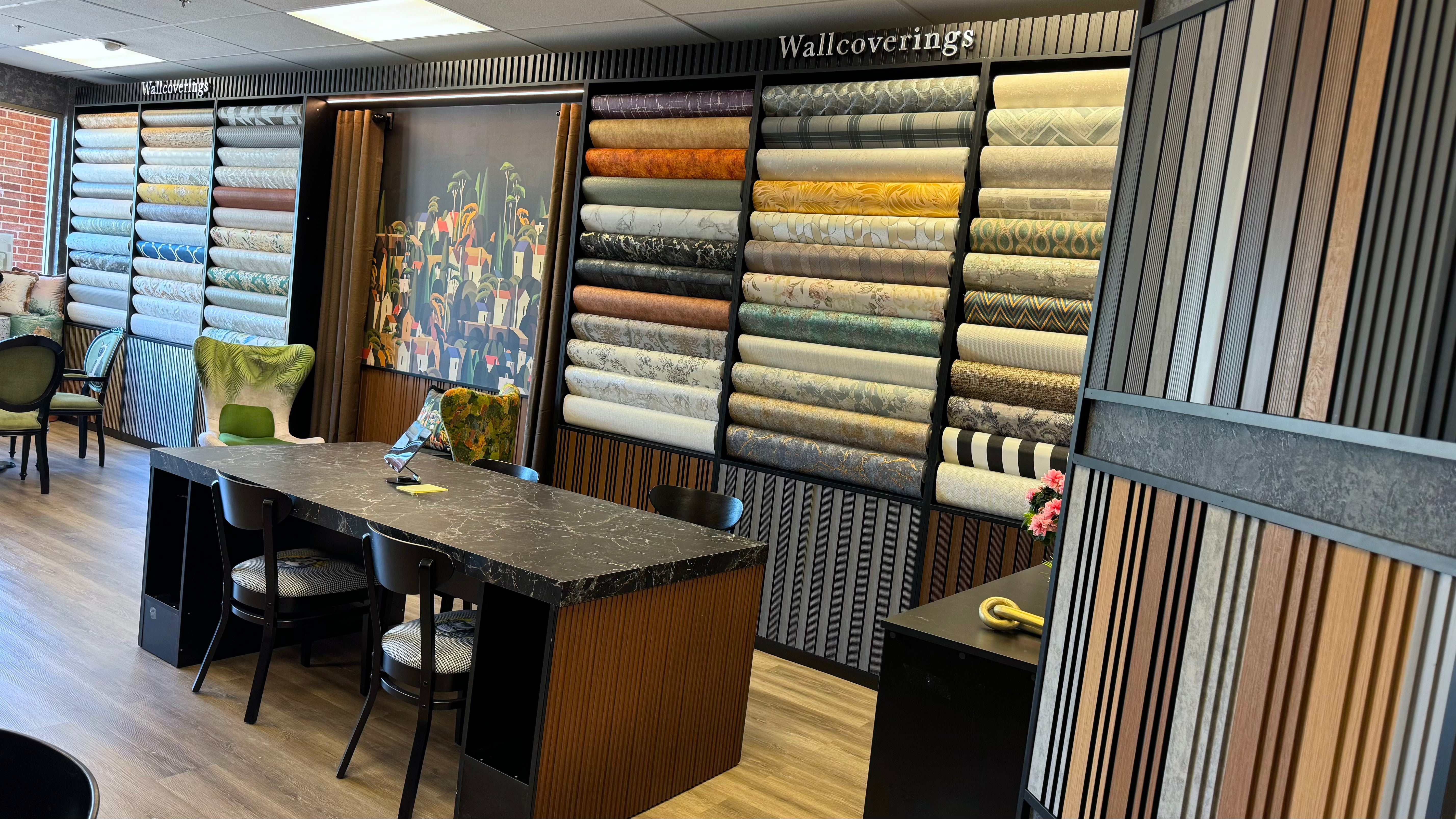

Does Wallpaper Actually Shrink Small Spaces?

Small rooms often get treated as if they come with a strict set of design rules: use light colors, avoid large patterns, keep the walls simple, and never use anything that might make the space feel more enclosed.
Wallpaper is frequently placed at the top of that "avoid" list.
But does wallpaper actually shrink small spaces?
Not necessarily. Wallpaper can make a compact room feel more enclosed when the color, pattern, scale, or contrast is poorly suited to the space. But the right wallcovering can also create depth, visual continuity, and architectural interest—sometimes making a small room feel more intentional and even more spacious.
The difference comes down to how the wallpaper interacts with the room.
Instead of asking whether wallpaper makes a room smaller, it is more useful to ask: What kind of wallpaper makes a small space feel larger, deeper, or more balanced?
Why Wallpaper Can Make a Small Room Feel Smaller
Wallpaper doesn't physically reduce the size of a room, of course. What changes is our visual perception of the space.
Certain designs create more visual activity across the walls. When that activity is too strong, the eye can perceive the room as more enclosed.
Several factors can contribute to this effect.
High-Contrast Patterns
A wallpaper with dramatic contrast between its background and pattern naturally attracts attention.
For example, black and white geometric wallpaper creates a much stronger visual impact than a soft beige pattern on a beige background.
That isn't necessarily a bad thing. It simply means the wallpaper becomes a dominant element.
In a very small room, too many dominant elements can compete with one another and make the space feel busy.
Very Dense Patterns
A pattern containing numerous closely packed motifs can create a sense of visual compression.
The eye has fewer quiet areas to rest, particularly when the wallpaper is visible across several walls.
This doesn't mean small rooms require completely plain walls. It means that visual breathing room matters.
Extremely Dark Colors
Dark wallpaper can make a small room feel more intimate because darker surfaces generally absorb more light.
However, dark wallpaper is not automatically wrong for a compact space.
In the right setting, a deep green, navy, charcoal, or brown can create a sophisticated, enveloping atmosphere.
The important question is whether you want the room to feel open and airy or intimate and dramatic.
How Wallpaper Can Make Small Spaces Feel Larger
The other side of the equation is much more interesting.
Wallpaper can create visual depth that paint alone may not provide.
A carefully chosen design can blur boundaries, establish continuity, emphasize height, or introduce subtle dimension to an otherwise flat wall.


Choose Low-Contrast Patterns for Visual Continuity
Low-contrast wallpaper is one of the easiest ways to introduce pattern without overwhelming a small space.
Think of combinations such as:
-
Warm white and cream
-
Beige and taupe
-
Soft gray and ivory
-
Muted green and sage
-
Pale blue and dusty blue
Because the colors are closely related, the pattern remains visible without creating harsh visual boundaries.
The result is a wall that feels layered rather than crowded.
Use Texture to Create Depth
Texture can be especially effective in compact interiors.
A textured wallcovering can create subtle changes in light and shadow across the surface, giving the walls more dimension.
Instead of adding artwork, shelves, decorative objects, and other elements to create visual interest, the wallpaper itself provides the detail.
This is one reason textured and embossed wallcoverings can work so well in sophisticated small spaces.
They add dimension without taking up physical space.
Think About Pattern Scale
Pattern scale is one of the most important considerations when choosing wallpaper for a compact room.
Small patterns can create a delicate rhythm across the walls.
Medium-scale designs can introduce more personality while remaining relatively balanced.
Large-scale patterns can be more dramatic, but they should not automatically be ruled out.
A large botanical or geometric pattern with plenty of negative space can actually create a striking sense of depth.
The real problem isn't necessarily a large pattern. It is often large pattern + high contrast + dense composition + too many competing elements.
Look at the entire combination rather than judging pattern size on its own.
Does Wallpaper on All Four Walls Make a Small Room Smaller?
This is where conventional advice can be misleading.
Many homeowners assume that wallpaper should only be used on one wall in a small room.
But a feature wall isn't always the best solution.
A single wallpapered wall introduces a clear contrast between the patterned wall and the painted walls. In some interiors, that contrast can visually divide the room.
Using the same subtle wallpaper across all four walls can instead create continuity.
The walls become one connected surface rather than four separate visual elements.
This approach can work particularly well with:
-
Tonal patterns
-
Subtle textures
-
Soft botanical designs
-
Small-scale motifs
-
Neutral color palettes
-
Low-contrast geometric patterns
So yes, wallpapering all four walls can sometimes make a small room feel larger and more cohesive than using wallpaper on only one wall.
When a Feature Wall Is the Better Choice
A feature wall still has an important place in small-space design.
If your wallpaper is bold, dramatic, or highly detailed, concentrating it on one wall can create a focal point without allowing the pattern to dominate the entire room.
Consider a feature wall behind:
-
A bed
-
A sofa
-
A dining table
-
A desk
-
A fireplace
-
A vanity
This gives the wallpaper a clear purpose.
Instead of competing with every element in the room, it establishes a visual destination.
Can Large Wallpaper Patterns Work in Small Rooms?
Absolutely.
This is one of the most useful design myths to challenge.
Large-scale wallpaper can create a sophisticated, editorial look in a small room.
The trick is to consider composition rather than simply scale.
A large botanical design with a calm background can feel surprisingly elegant.
A large geometric pattern with excessive contrast may feel much more intense.
A large pattern can also reduce the visual repetition created by tiny motifs.
Instead of the eye constantly registering dozens of small elements, it reads the overall composition as one larger visual statement.
This can make the wall feel more expansive.
Vertical Patterns Can Change the Perception of Height
Small rooms are not always small because they lack floor area. Sometimes the problem is low ceilings.
Wallpaper can help manipulate the perception of proportions.
Vertical stripes, elongated geometric designs, tall botanical motifs, and patterns with upward movement can encourage the eye to travel vertically.
This can make the ceiling appear higher.
You don't necessarily need obvious stripes. Look for wallpaper with a vertical visual rhythm.
The goal is to make the room feel taller without physically changing its architecture.
Horizontal Patterns Can Help Narrow Rooms
If a room is narrow rather than simply small, horizontal movement can be useful.
Horizontal lines and elongated patterns can visually emphasize width.
This can be especially helpful in:
-
Narrow bedrooms
-
Hallways
-
Compact dining rooms
-
Long living rooms
Again, the effect doesn't have to come from traditional stripes.
Broad geometric compositions or horizontally oriented motifs can produce a similar visual movement.
Don't Ignore the Ceiling
When trying to make a small room feel larger, homeowners often focus entirely on the walls.
But the ceiling has a significant influence on how we perceive the room.
A bright ceiling can create openness.
A darker ceiling can make a room feel more intimate.
In some interiors, extending wallpaper onto the ceiling can create a dramatic cocoon effect. This can be particularly effective in powder rooms, bedrooms, and intimate dining spaces.
It isn't necessarily a technique for making a room appear physically larger—but it can make the entire interior feel more intentional and immersive.
Lighting Changes Everything
The same wallpaper can look completely different depending on the room's lighting.
Natural daylight may reveal subtle texture and make a color appear lighter.
Warm artificial lighting can make beige, cream, and brown tones feel richer.
Cooler lighting can emphasize blue and gray undertones.
Before making a final decision, view your wallpaper sample:
in the morning, during the afternoon, and under evening lighting.
This is particularly important when choosing textured wallpaper or darker colors.
A small room with limited natural light may benefit from wallpaper that reflects rather than absorbs available light.
Use Furniture to Balance the Wallpaper
Wallpaper doesn't exist independently from the rest of the interior.
Furniture scale matters.
A small room filled with oversized furniture can already feel crowded before wallpaper is introduced.
If you are using a strong wallpaper, consider balancing it with furniture that has:
-
Clean silhouettes
-
Appropriate proportions
-
Simple upholstery
-
Open or elevated bases
-
Limited visual bulk
The goal is not to make every element minimal.
It is to give the wallpaper enough space to be appreciated.
Wallpaper and Mirrors: A Powerful Combination
Mirrors can help reflect light and create the perception of additional space.
Pairing a mirror with wallpaper can create an interesting layered effect.
A large mirror placed against a textured or subtly patterned wall can reflect both the room and the wallcovering, creating additional visual depth.
This works particularly well in:
-
Entryways
-
Powder rooms
-
Small bedrooms
-
Narrow hallways
The wallpaper provides character while the mirror introduces reflection.
Small Spaces Don't Have to Be Visually Empty
One of the biggest mistakes in small-space design is assuming that everything needs to be minimal.
A small room doesn't necessarily need fewer design elements.
It needs better relationships between those elements.
Wallpaper can provide color, texture, pattern, and architectural character without adding another physical object to the room.
That can actually be an advantage.
Instead of filling a compact room with decorative accessories, you can let the walls carry more of the design responsibility.
Wallpaper for Small Bathrooms and Powder Rooms
Small bathrooms and powder rooms are particularly good candidates for wallpaper.
Because these spaces are often limited in size, they can benefit from a strong visual identity.
A bold wallpaper can turn a compact powder room into a memorable design moment.
For spaces with appropriate ventilation and moisture conditions, choose a wallcovering suitable for the environment and follow the manufacturer's installation recommendations.
Here, making the room appear larger isn't necessarily the primary objective.
Sometimes the better goal is to make a small space feel luxurious, dramatic, and complete.
How to Choose Wallpaper for a Small Space
If you're unsure where to start, use this simple checklist.
Start With the Room's Natural Light
Bright rooms give you more flexibility with color and pattern.
Dark rooms may benefit from lighter or reflective designs, depending on the atmosphere you want.
Decide on the Mood
Do you want:
-
Airy and calm?
-
Warm and intimate?
-
Dramatic and sophisticated?
-
Natural and relaxed?
-
Contemporary and architectural?
Your desired mood should influence your wallpaper choice.
Consider the Pattern's Density
Look at the amount of visual information in the design.
A pattern with negative space can feel much lighter than a dense pattern with the same overall color.
Think About All Four Walls
Don't automatically assume that one feature wall is the safest option.
Ask whether continuous wallpaper would create better visual flow.
Test a Large Sample
A small wallpaper swatch can be deceptive.
Whenever possible, view a larger sample against the actual wall and alongside your furniture, flooring, and lighting.
Common Small-Space Wallpaper Mistakes
Choosing Wallpaper Only Because It Is "Light"
Light wallpaper isn't automatically the best choice.
A poorly scaled or overly busy light pattern can still create visual clutter.
Avoiding All Bold Designs
Small rooms can handle bold design.
The key is balance.
A dramatic powder room or intimate dining area may actually benefit from stronger wallpaper.
Ignoring the Rest of the Room
Wallpaper should coordinate with furniture, flooring, window treatments, lighting, and accessories.
Don't evaluate it in isolation.
Using Too Many Competing Patterns
If the wallpaper is already expressive, keep rugs, upholstery, curtains, and accessories from competing for attention.
Forgetting Texture
Pattern isn't the only way to create visual interest.
A sophisticated textured wallpaper can add depth while maintaining a relatively calm visual appearance.
Frequently Asked Questions
Does wallpaper make small rooms look smaller?
It can, but not always. Dark, highly contrasting, or densely patterned wallpaper can make a room feel more enclosed. Subtle patterns, appropriate scale, texture, and cohesive color can create depth instead.
What wallpaper is best for a small room?
There is no single best option, but low-contrast patterns, subtle textures, tonal designs, and appropriately scaled motifs are versatile choices for many compact interiors.
Should I use wallpaper on all four walls of a small room?
You can. Full-wall wallpaper can create visual continuity and may work particularly well when the design is subtle or textured.
Is dark wallpaper bad for small rooms?
No. Dark wallpaper can create an intimate and sophisticated atmosphere. It simply produces a different visual effect from light wallpaper.
Can large patterns make a small room look bigger?
They can. A large-scale design with thoughtful composition and sufficient negative space can create depth and a strong sense of design without necessarily making the room feel crowded.
Does textured wallpaper work in small spaces?
Yes. Texture can add dimension and visual interest without relying on a highly detailed pattern, making it a strong option for compact interiors.
Final Thoughts
So, does wallpaper actually shrink small spaces?
Not physically—and not necessarily visually.
Wallpaper becomes a problem only when its color, scale, contrast, texture, and placement work against the proportions and lighting of the room.
The right design can do the opposite. It can create continuity across walls, introduce depth, emphasize ceiling height, add architectural character, and give a compact interior a stronger sense of identity.
For some rooms, that means a subtle wallpaper across all four walls. For others, it means a dramatic feature wall. And sometimes the most successful choice is a bold design that completely embraces the room's intimate proportions.
At Walloro, wallpaper is viewed as more than a decorative surface. It is a tool for shaping how an interior is experienced—from the way light moves across texture to the way pattern influences visual balance.
A small space doesn't need to look bigger to feel exceptional. It simply needs a design that understands its proportions.