


How Wallpaper Creates Definition in Open-Plan Rooms
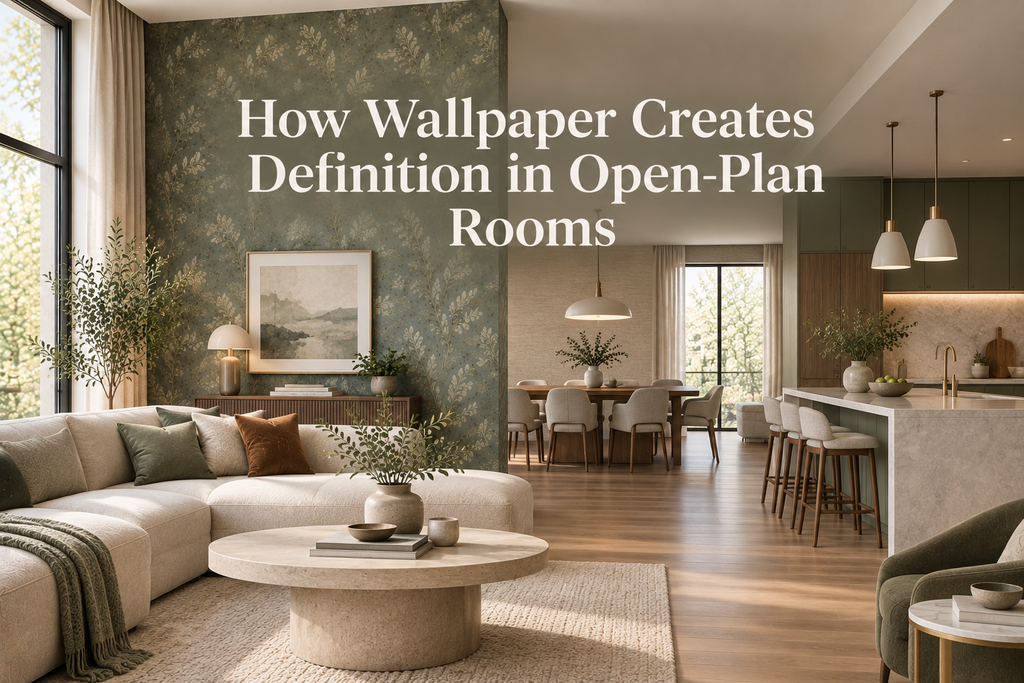
Open-plan interiors are designed around connection. The kitchen, dining area, living room, and sometimes even the home office can exist within one continuous footprint, allowing light, movement, and conversation to flow naturally from one area to another.
But openness creates its own design question: how do you give different parts of a large room a sense of identity without actually separating them?
Wallpaper can provide an elegant answer.
Rather than building walls, adding partitions, or relying entirely on furniture, wallpaper can create visual definition through color, pattern, texture, scale, and placement. A carefully selected wallcovering can tell the eye where one area begins and another ends while preserving the openness that makes the room work.
This is where wallpaper becomes more than a decorative finish. It becomes part of the spatial composition.
Open-Plan Does Not Have to Mean Visually Uniform
One of the common misconceptions about open-plan design is that everything needs to match.
In reality, a successful open-plan interior usually contains several distinct visual zones. The living area should feel like a place to relax. The dining area may feel more social or formal. A workspace needs concentration. The kitchen may require a more functional atmosphere.
These areas can share the same physical space while having different visual identities.
The challenge is creating distinction without making the room feel fragmented.
Wallpaper is particularly effective because it introduces definition without introducing a physical barrier.
A wall can become a visual boundary without becoming an architectural obstacle.
Wallpaper as a Tool for Visual Zoning
Furniture naturally creates some separation in an open-plan room.
A sofa can indicate where the living area ends. A dining table can establish the dining zone. An island can distinguish the kitchen.
But furniture alone doesn't always provide enough visual structure.
Wallpaper can reinforce these boundaries.
A patterned wall behind a dining table immediately establishes the dining area as a destination. A textured wall behind a sofa can give the living room greater presence. A distinctive wallcovering behind a desk can make a workspace feel intentional rather than temporary.
The physical floor plan doesn't change.
The perception of the space does.
Start With the Room's Existing Architecture
Before choosing a wallpaper, examine the architecture that already exists.
Look for:
-
Columns
-
Beams
-
Ceiling changes
-
Alcoves
-
Recessed walls
-
Built-in cabinetry
-
Doorways
-
Window groupings
-
Partial walls
-
Changes in floor direction
These elements can provide natural stopping points for wallpaper.
Instead of forcing a boundary where none exists, use the architecture to determine where a visual transition already makes sense.
This creates a more convincing result because the wallpaper appears to belong to the structure of the room rather than being placed arbitrarily on it.
The Anchor Wall
One of the most effective approaches is to identify an anchor wall.
An anchor wall is a surface that naturally attracts attention because of its location, proportions, or relationship to furniture.
In an open-plan interior, this might be:
-
The wall behind the sofa
-
The wall behind the dining table
-
A fireplace wall
-
A built-in shelving wall
-
A home office backdrop
-
A wall visible from the entrance
Wallpapering this surface can establish a visual center without requiring additional decoration.
The result can be particularly powerful when the wall is visible from several areas of the open-plan room.
Defining the Dining Area
Dining spaces often benefit from stronger visual definition.
A dining table can sometimes appear to float within a large open room, particularly when there is no surrounding wall architecture.
Wallpaper can give the table a visual backdrop.
A sophisticated geometric design can introduce structure. A botanical pattern can create atmosphere. A textured wallcovering can provide depth without competing with the dining furniture.
The goal isn't necessarily to make the dining area dramatically different.
It is to make it feel intentional.
Giving the Living Area a Visual Center
Large open-plan living rooms can sometimes lack a clear focal point.
Wallpaper can solve this by establishing a visual anchor behind the main seating arrangement.
Instead of relying on a collection of artwork, shelving, or accessories to create interest, a wallcovering can provide the entire backdrop.
This is particularly effective with designs that use texture, subtle dimensionality, or carefully controlled pattern.
The wall becomes part of the furniture composition.
The sofa no longer sits simply in front of a blank surface. It becomes part of a larger visual arrangement.
Using Wallpaper to Define a Workspace
The growing presence of work-from-home areas has created another challenge for open-plan interiors.
A desk positioned at the edge of a living room can easily feel temporary.
Wallpaper can give that space a stronger sense of purpose.
A distinct wall behind the desk can visually frame the workspace and establish a subtle boundary between work and relaxation.
This doesn't require a separate room.
The wallcovering communicates the change in function.
Color Can Create Boundaries Without Hard Edges
Wallpaper doesn't have to rely on dramatic patterns to define space.
Color alone can create visual separation.
Imagine an open-plan interior with a predominantly warm neutral palette. A deeper olive, muted blue, rich terracotta, or charcoal wallcovering could establish one particular zone without overwhelming the rest of the room.
The transition is felt rather than physically seen.
This approach is especially useful when the architecture is minimal and the homeowner wants a refined, understated result.
Texture Can Be Even More Subtle
For interiors that rely on quiet color palettes, texture can provide definition without introducing a strong change in hue.
Embossed or textured wallpaper can create a visual distinction through light and shadow.
During the day, natural light moves across the surface and reveals subtle variations. In the evening, artificial lighting can create another layer of depth.
The zone becomes distinct because the wall behaves differently from the surrounding surfaces.
This is one reason texture can be particularly effective in sophisticated interiors.
Pattern Scale Matters
A wallpaper pattern doesn't exist in isolation.
Its scale needs to relate to the size of the room and the distance from which it will be viewed.
In a large open-plan interior, a very small pattern may become visually insignificant when viewed from across the room.
A larger-scale design can maintain its presence across longer sightlines.
However, that doesn't mean larger is always better.
A dramatic pattern can become overwhelming when placed next to equally strong furniture, flooring, lighting, or artwork.
The goal is proportion.
Wallpaper should have enough visual weight to define the zone without becoming the only thing the eye notices.
Consider the Longest Sightline
Open-plan rooms are experienced from multiple directions.
You may see the dining wall from the kitchen. The living room may be visible from the entrance. A workspace may sit within the peripheral view of the seating area.
That means wallpaper needs to work beyond the wall itself.
Before committing to a design, consider how it looks:
-
From the entrance
-
From the kitchen
-
From the dining table
-
From the sofa
-
From adjacent hallways
-
From other connected rooms
A successful wallpaper choice should contribute to the overall composition from several viewpoints.
One Wallpaper Can Be Enough
Defining an open-plan interior does not mean using several wallpapers.
In many cases, one carefully selected wallcovering creates a stronger result than multiple competing designs.
For example, a single statement wall behind the dining table can establish the dining area while the living and kitchen areas remain visually quieter.
This creates hierarchy.
Instead of giving every zone equal visual weight, the wallpaper tells the eye where to pause.
Multiple Wallpapers Can Work—With a Clear Relationship
There are situations where more than one wallpaper can be appropriate.
Perhaps the living room and dining area are large enough to support distinct treatments.
Perhaps the open-plan interior includes several architectural transitions.
In these cases, the wallpapers don't need to match exactly.
They should, however, share something.
That connection might come from:
-
Color
-
Undertone
-
Pattern scale
-
Texture
-
Material character
-
Visual rhythm
The objective is not repetition.
It is relationship.
Think in Terms of Visual Hierarchy
Every open-plan room has elements competing for attention.
Furniture, artwork, lighting, flooring, windows, architectural features, and wallpaper all contribute to the visual hierarchy.
Wallpaper should have a deliberate position within that hierarchy.
If the furniture is highly sculptural, a quieter wallcovering may provide balance.
If the furniture is minimalist, wallpaper can carry more of the visual character.
If the room already has dramatic architecture, subtle texture may be enough.
The question isn't simply, "What wallpaper do I like?"
A more useful question is:
"What role should the wallpaper play in this room?"
Connect the Zones Through Color
Even when different areas have different treatments, color can maintain continuity.
Consider an open-plan space built around:
Warm white + walnut + muted green + brushed metal
The living room might use a soft textured wallcovering.
The dining area could introduce a deeper botanical pattern.
The kitchen might remain relatively quiet.
The spaces feel different, but the same visual vocabulary travels through the room.
This is what makes the design feel intentional rather than fragmented.
Use Existing Materials as Inspiration
The surrounding materials can help determine which wallpaper belongs in the space.
Look at:
-
Wood flooring
-
Stone countertops
-
Cabinet finishes
-
Upholstery
-
Rugs
-
Metal fixtures
-
Curtains
-
Lighting
Wallpaper can repeat a subtle undertone from these materials or introduce a controlled contrast.
For example, a wallpaper with warm mineral tones can connect a stone surface to wooden furniture. A cool gray-blue pattern can reinforce metal fixtures and neutral upholstery.
The wallpaper becomes part of the material conversation.
Wallpaper Can Create Intimacy Within a Large Room
Large open spaces can sometimes feel visually impressive but emotionally distant.
Wallpaper can change that.
A darker or more textured wallcovering can create a sense of intimacy around a dining table or seating area.
This doesn't mean the entire room needs to become darker.
Instead, one zone can have a more enclosed visual character while the surrounding areas remain open and bright.
This contrast can make a large room feel more layered.
Don't Ignore the Ceiling
In an open-plan interior, the ceiling often acts as one continuous visual plane.
This can be useful because it connects multiple zones even when their walls are treated differently.
If one area has wallpaper and another does not, the uninterrupted ceiling helps maintain continuity.
If the architecture includes different ceiling heights, beams, or transitions, those features can become natural points for changing the wallpaper treatment.
The relationship between wall and ceiling should always be considered together.
What About Furniture Placement?
Furniture and wallpaper should work together, but they don't need to match.
In fact, designing the wallpaper entirely around furniture can sometimes make the result feel overly coordinated.
Instead, think about composition.
A wallpapered wall can provide the backdrop.
Furniture can sit within that composition.
Artwork can become another layer.
Lighting can reveal texture.
Accessories can introduce smaller accents.
This creates depth because every element has a different role.
Avoid Creating Too Many Focal Points
One of the most common mistakes in open-plan interiors is trying to make every area dramatic.
A bold wallpaper behind the dining table, another statement wall behind the sofa, dramatic lighting, patterned furniture, and elaborate accessories can quickly compete for attention.
A sophisticated interior usually benefits from hierarchy.
Choose where the strongest visual statement belongs.
Then allow the surrounding areas to support it.
Common Mistakes When Using Wallpaper in Open-Plan Rooms
Treating Every Zone as a Separate Room
The purpose of visual zoning is distinction, not fragmentation.
Using Too Many Patterns
Multiple patterns can work, but they need a clear relationship.
Ignoring Sightlines
A wallpaper that looks beautiful from one position may conflict with another area when viewed across the open plan.
Choosing Wallpaper Before Considering Materials
Flooring, cabinetry, furniture, and lighting should all be part of the decision.
Making Every Wall a Feature
A focal point becomes less effective when everything competes for attention.
Forgetting About Scale
The pattern needs to work with both the physical dimensions of the wall and the distance from which it will be seen.
A Practical Framework for Defining an Open-Plan Room
Before selecting wallpaper, consider these seven questions:
1. What functions exist within the open space?
Identify the living, dining, kitchen, work, or relaxation zones.
2. Which area needs the strongest definition?
Not every zone needs equal visual emphasis.
3. Where is the natural anchor wall?
Look at the walls behind major furniture or architectural features.
4. What are the longest sightlines?
Make sure the wallpaper works from across the entire room.
5. Which colors already connect the space?
Look at flooring, furniture, cabinetry, and accessories.
6. Would pattern or texture work better?
A bold pattern creates stronger definition, while texture can provide a quieter transition.
7. Does the wallpaper strengthen the architecture?
The strongest placement usually feels as though it was always meant to be there.
Frequently Asked Questions
Can wallpaper really divide an open-plan room?
Wallpaper doesn't physically divide a room, but it can create a clear visual distinction between functional areas. This allows an open layout to feel organized without sacrificing openness.
Should I wallpaper the entire open-plan room?
Not necessarily. A strategically selected wall can often create stronger definition than covering every available surface.
Can I use different wallpaper in different areas?
Yes. Different wallpapers can work when they share a relationship through color, undertone, texture, scale, or overall visual character.
What is the best place for wallpaper in an open-plan room?
Common choices include the wall behind a sofa, dining table, desk, fireplace, or other architectural focal point.
Can textured wallpaper define space without bold color?
Yes. Texture can create distinction through depth, light, and shadow while maintaining a restrained color palette.
Final Thoughts
Open-plan design is ultimately about balance.
You want connection without uniformity. You want distinct areas without hard divisions. You want personality without visual clutter.
Wallpaper can occupy that space between architecture and decoration.
A thoughtfully chosen wallcovering can establish a dining area, anchor a living room, frame a workspace, or create intimacy within a large interior—all without changing the physical structure of the room.
The key is not simply deciding where wallpaper should go.
It is understanding why it should go there.
When wallpaper responds to architecture, sightlines, furniture placement, materials, and the way people move through a space, it becomes more than a decorative surface.
It becomes a tool for defining how an open-plan room is experienced.
And that is where wallpaper has the potential to do something surprisingly architectural: create boundaries without building walls.